Transcription in Psychotherapy
Transcribe therapy sessions. And continue to reflect on the case.
mentalhealthGPT creates a word-for-word transcript of your session. Your device replaces names before anything reaches the AI. Then the real work begins: Your personal AI clinical assistant knows the case history across all sessions, answers questions about the case, and helps with summarizing and documenting.
Four Ways to Get a Transcript.
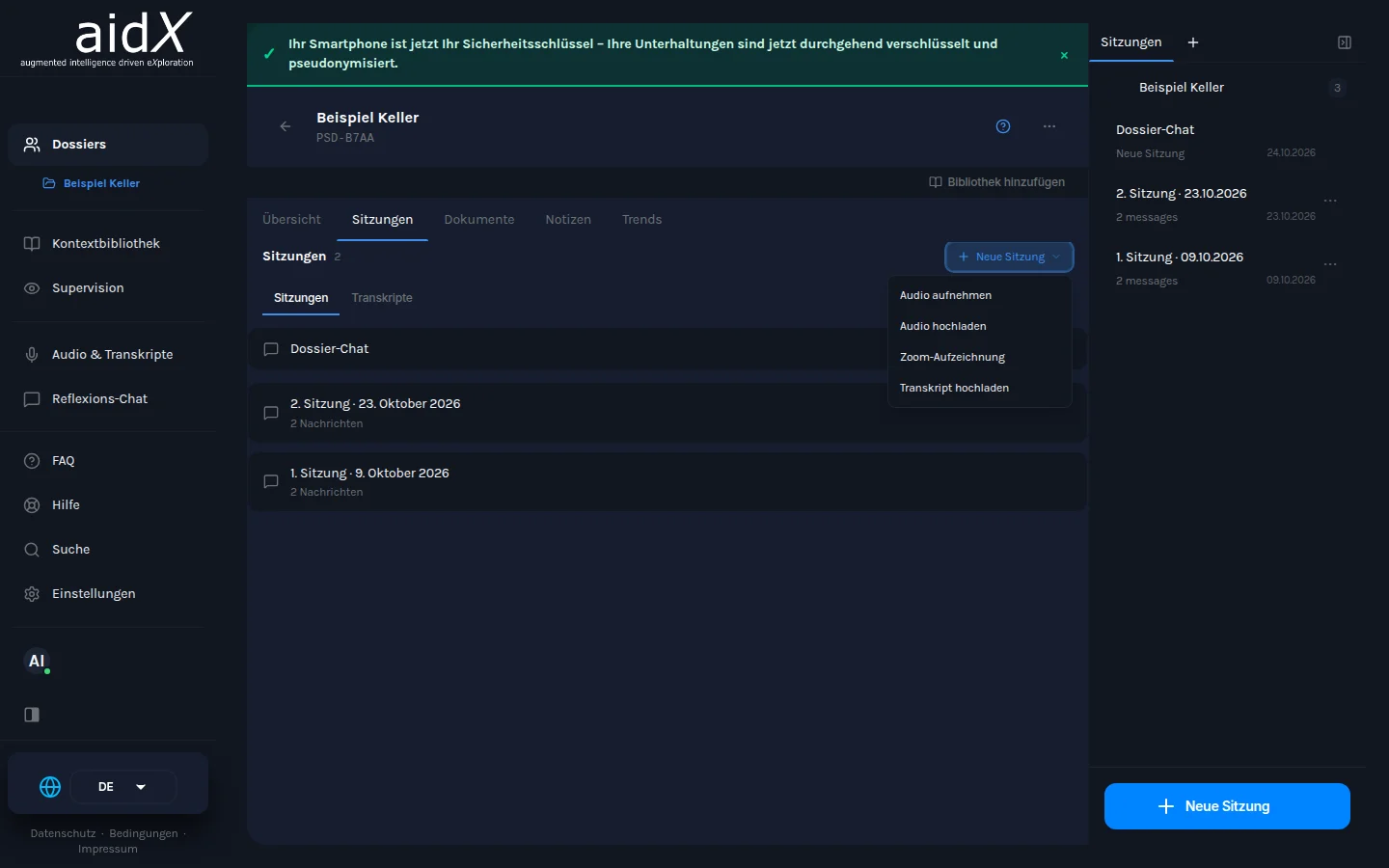
Whether you're recording in the consultation room, working online, or already have a transcript: The session is added as text to the Dossier, your digital case file.
- Record audio in your browser without installing an app. Speech recognition runs on your device; the audio never leaves it.
- Upload audio: an existing recording, transcribed on your device as well.
- Zoom-Session: The audio is transmitted to your browser via our infrastructure, where it is transcribed and not stored on our servers.
- Upload a transcript: an existing transcript as text.
Recordings may only be made with your client's informed consent. Information and Consent Form →
For reliable speaker separation, we recommend small, portable wireless microphones. Recommended setups →
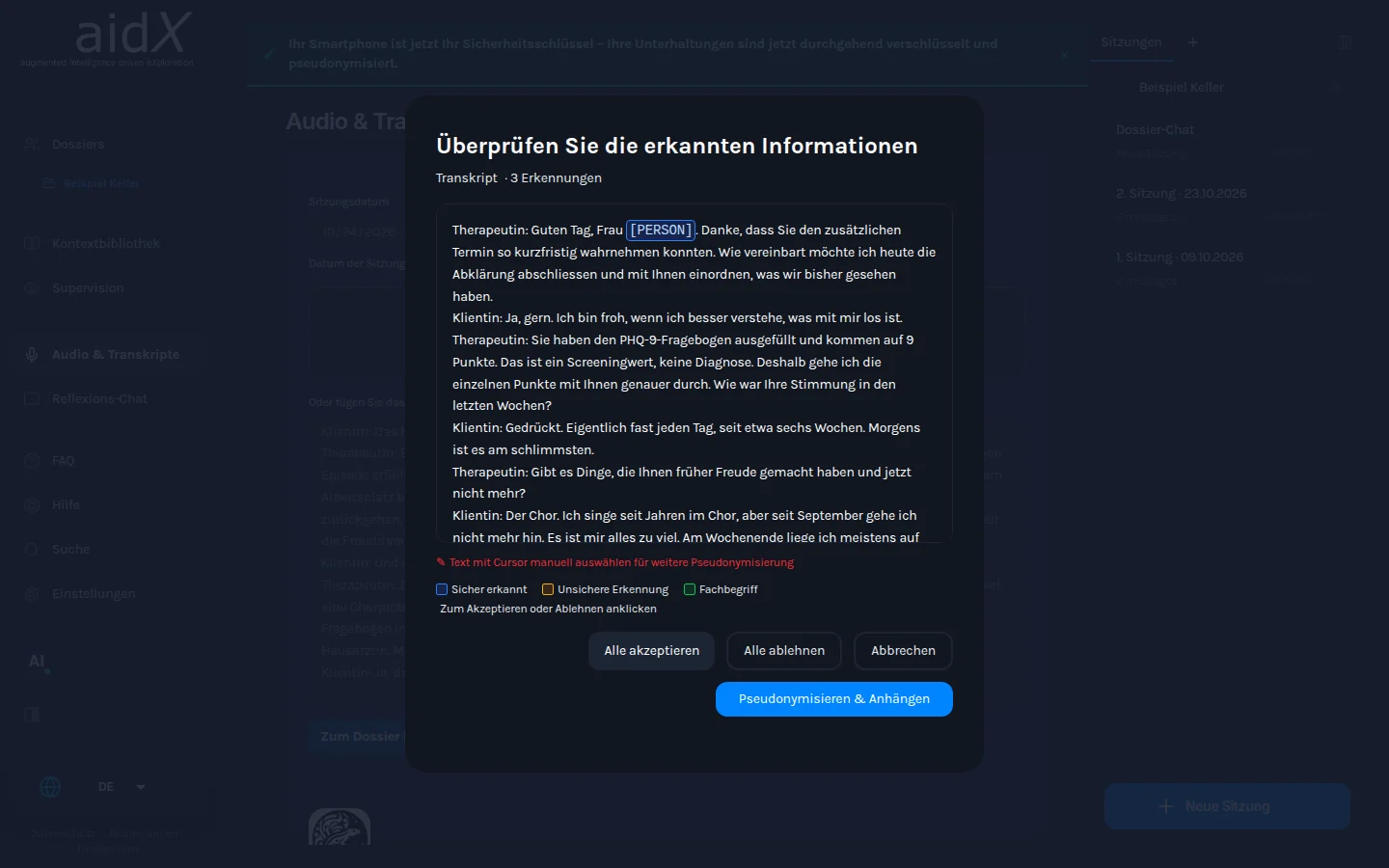
You check before anything leaves your device.
A model on your device detects names and other identifying information and replaces them with placeholders. You can accept or reject each detection, and you can mark any overlooked sections yourself. Technical terms, such as diagnoses, remain in the text for professional purposes.
Detection does not guarantee complete anonymity, and the clinical context may also allow for conclusions to be drawn about an individual. Therefore, your review remains a mandatory step, and pseudonymized content will continue to be treated as personal data requiring special protection.
A transcript alone does not constitute case knowledge.
A transcription service stops at the text. In mentalhealthGPT , each session becomes part of the case file, along with notes and documents. This builds up documented case knowledge over time, so you don't have to explain the case from scratch every time.
- 1st SessionOctober 9, 2026
- 2nd SessionOctober 23, 2026
- 3rd SessionOctober 24, 2026
- Next sessionadds to the picture
What Your AI Assistant Draws Upon
To the extent that this applies to your case:
- Verified EvidenceVerified evidence from your sessions
- Case ContextTranscripts, previous sessions, notes, and documents in the case file
- ExpertiseSpecialized library featuring the WHO ICD-11, guidelines, and specialized literature
Example using a hypothetical case. The three sessions from the example on the home page.
Ask questions. Connect sessions. Reflect on cases.
In the case file chat, you interact with an AI that is familiar with the documented history. It helps you reflect on the case without relieving you of your professional responsibility.
- Reflection on the session at the push of a button: how the session fits into the documented case history and what questions remain.
- Testing hypotheses, identifying patterns, across sessions.
- Understand the basis for a response: what is supported by a session and what remains an assessment.
- Honest when the evidence is insufficient: missing evidence is identified, not glossed over.
In the Dossier chat, you can ask, for example,
- “Summarize the course of the case across all sessions.”
- "What might I be overlooking with this client?"
- “What should I clarify in the next session?”
- "Prepare a case presentation for the Supervision ."
- "What is your answer based on?"
From Transcript to Documentation.
Summaries and reports are based on case knowledge, not on a single session. Every piece of information can be verified back to the session through source citations. Reports are created as drafts; you review and approve them yourself. You can add your own notes to the dossier.
From the template catalog, including:
If a template is missing, request it directly in the app.
The client, who is employed, reports an overwhelming workload with long hours that extend late into the evening, as well as a feeling that she can never finish her tasks. Feedback from her supervisor, which she perceived as mediocre, triggered persistent rumination and feelings of inadequacy. …
2nd session · 23 October 2026Review – clinical evidence incomplete
Insufficient clinical evidence
Three additional fields not shown
What happens to your session, Step by Step.
"Is this in compliance with data protection regulations?" is not a question that can be answered in a single word. Here you can see where each step takes place and what you can do to help.
| Step | Where | What happens |
|---|---|---|
| Speech Recognition | on your device | When you record and upload, the audio never leaves your device. With Zoom , it is routed through our infrastructure to your browser and is not stored. |
| Pseudonymization | on your device | Names and identifiers are replaced with placeholders; you check each match. The matching process may overlook some details. |
| Storage | in Switzerland | Transcripts, notes, and reports are stored in encrypted form, with a unique key for each piece of content. Only your devices can link the content to real names. |
| AI Analysis | in Switzerland or the EU | The pseudonymized version is processed. Your content is not used to train AI models. |
- Your contribution: obtaining your client’s informed consent, carefully reviewing the identified personal data, and professionally reviewing each report before it is used.
- Our framework: mentalhealthGPT is designed in accordance with the Swiss Data Protection Act and the GDPR. The way we process data on your behalf is governed by the Data Processing Agreement (DPA) and the technical and organizational measures (TOM).
About the transcription.
Is the audio recording saved?
Not on our servers. During recording and upload, speech recognition runs in your browser; the audio never leaves your device. With Zoom , the audio is routed through our infrastructure to your browser, where it is transcribed but not stored. Only the text—pseudonymized and encrypted—is added to the dossier.
Can I use existing transcripts?
Yes. You can upload an existing transcript as text. It undergoes the same verification of personal information as an audio recording.
What if a client does not want to be recorded?
You can work without a recording, for example with a transcript or written account of the conversation that you add yourself, with notes or with documents.
Does mentalhealthGPT create summaries and notes for a session?
Summaries are generated from the dossier: for example, in the dossier chat, a summary of the progress made across all sessions; as a report, for example, a progress report or a summary at the conclusion. Reports are created as drafts; you review and approve them yourself. You can add your own notes to the dossier.
Do I need my client's consent?
Yes. Recordings may only be made with your client's informed consent. A ready-to-use information and consent form is available.
Are my sessions used to train AI models?
No. Your content is not used to train AI models or for the general development of our product, not even in pseudonymized form.
What kind of microphone do I need?
For reliable speaker separation, we recommend small, portable wireless microphones. Recommended setups can be found in the Help section.
Experience it with your own case.
Try it free for 30 days. All available features. Up to three dossiers. No credit card required.