For Your Clients
Information and Consent, in Everyday Language.
You don't need to write anything yourself. Enter your practice details, go over the form with your client, and have them sign the consent form.
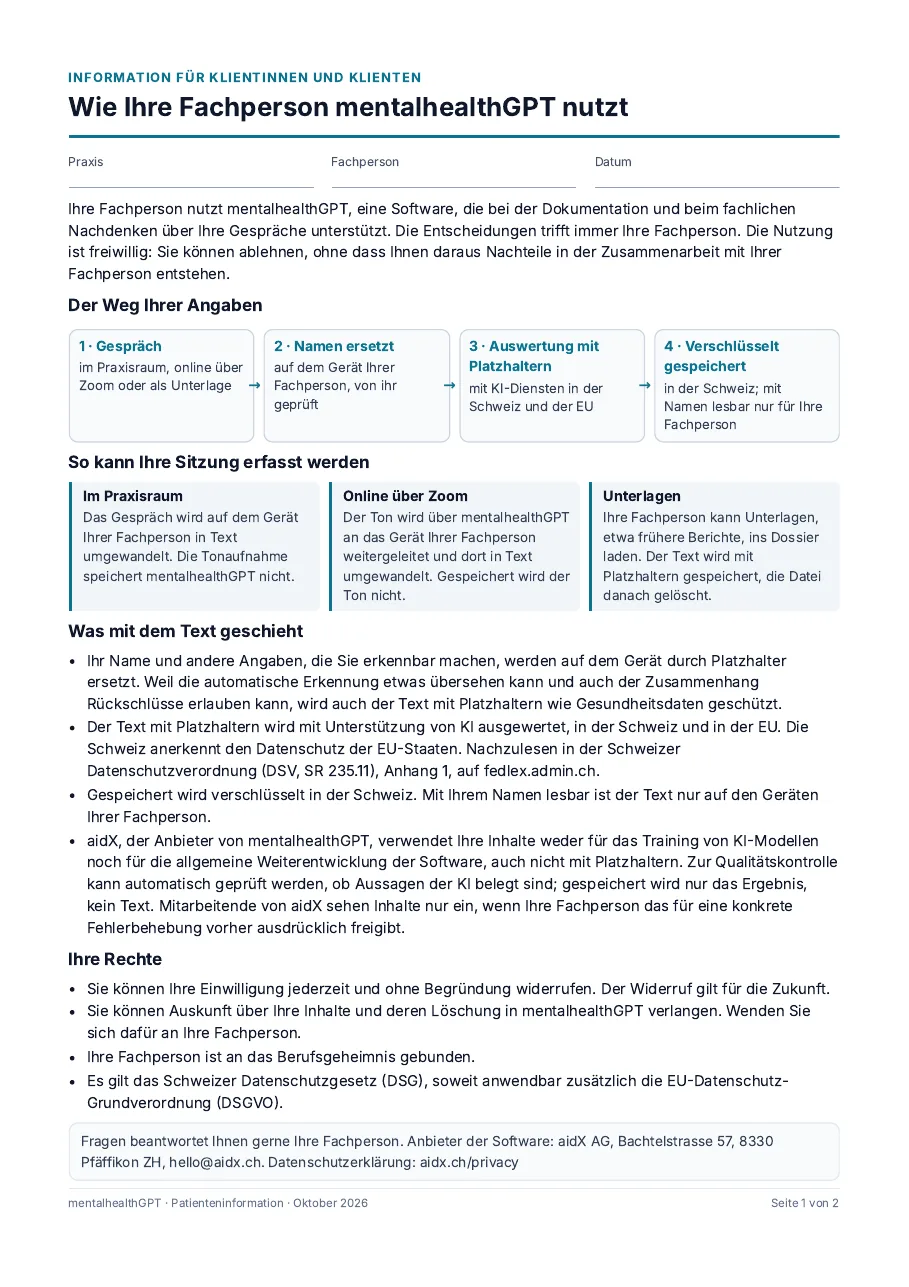
From conversation to storage.
That's exactly what it says on the template, in everyday language. The text is analyzed using placeholders instead of names, and only your device can link it back to the actual names.
Switzerland recognizes the data protection laws of EU member states.
As noted by the Federal Council: All 27 EU member states are on the list. Appendix 1 on fedlex.admin.ch →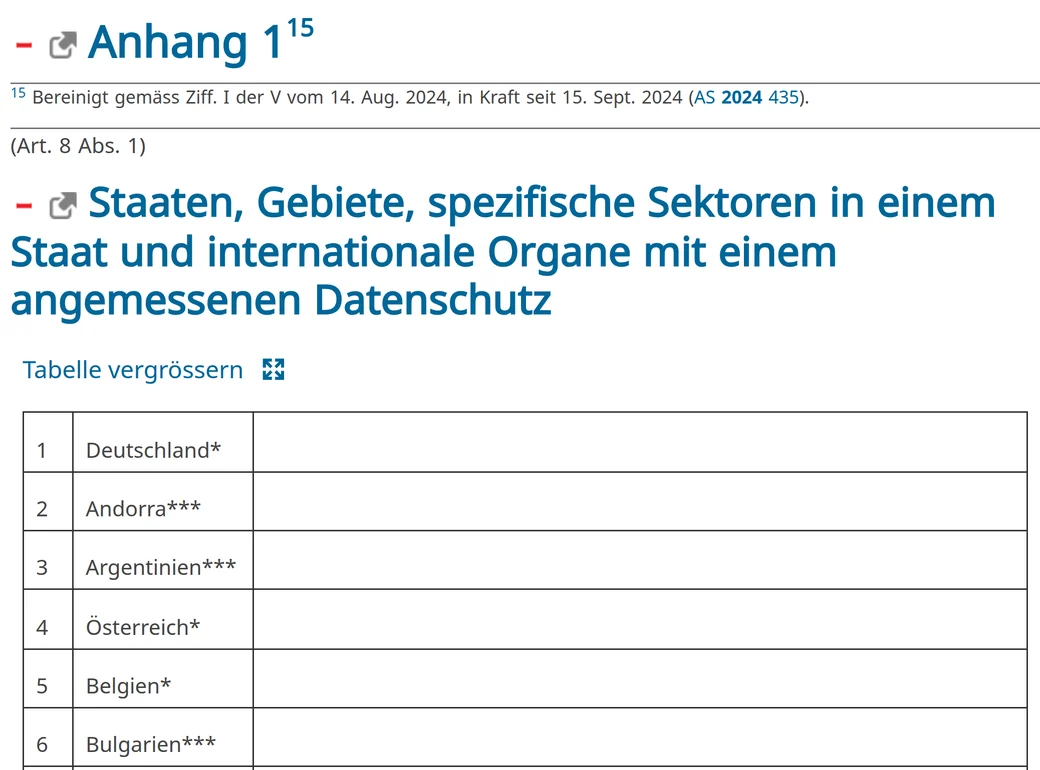
What happens to audio and files.
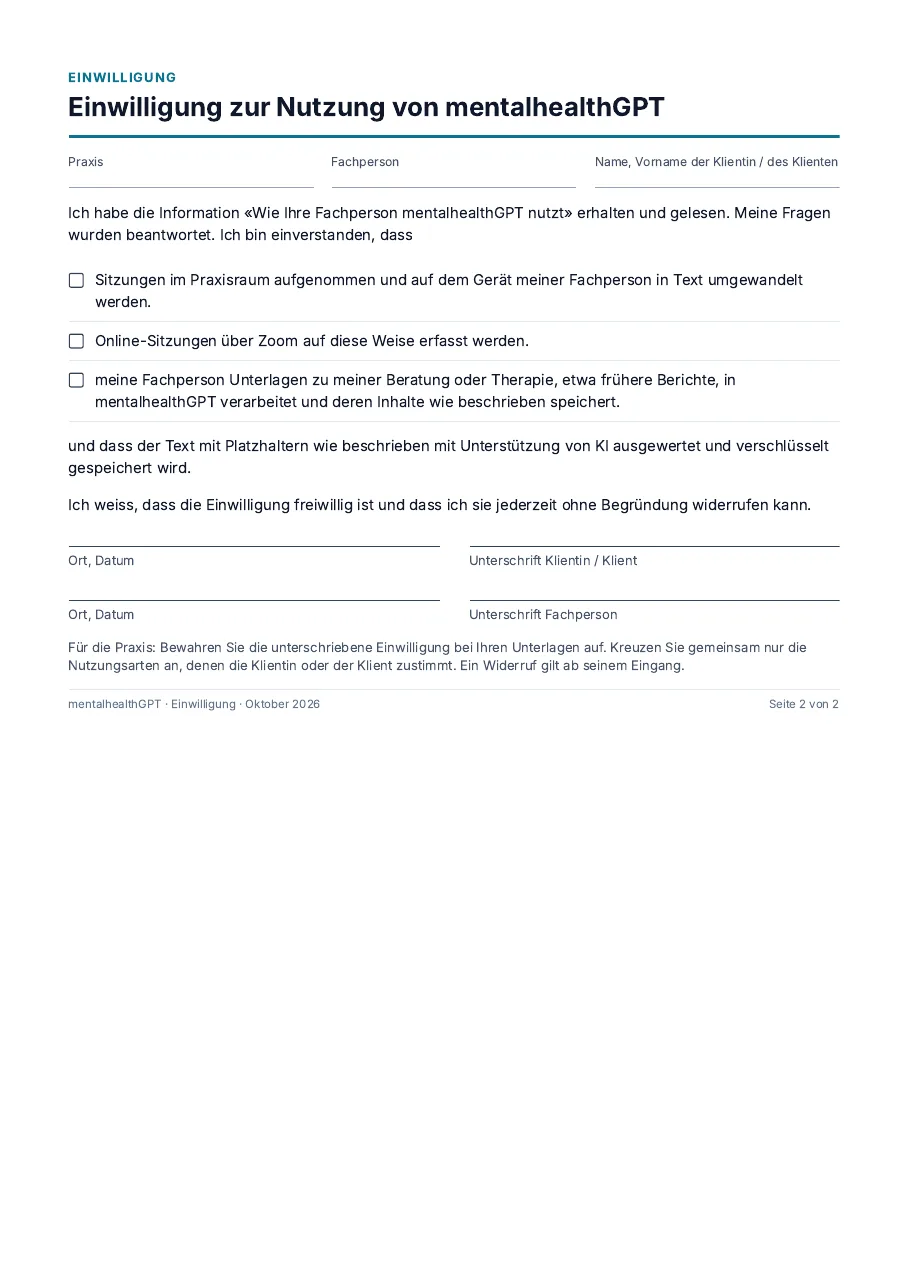
The form covers all three options. On the consent form, you and your client should only check the boxes indicating what your client agrees to.
The conversation will be transcribed into text on your device.
- Sound: Does not leave the device and is not saved.
- Let's continue: just the text, with placeholders instead of names.
The audio is sent to your browser via mentalhealthGPT , where it is converted into text.
- Audio: is not stored on our servers.
- Let's continue: just the text, with placeholders instead of names.
Upload preliminary reports or findings to the dossier. The text is parsed and saved with placeholders instead of names.
- File: The uploaded version will be deleted after processing.
- The original file on your device remains unchanged.
Two sides, clearly distinct.
- Page 1, Information: written in everyday language, covering how information is provided, the three options, and your client's rights.
- Page 2, Consent: Check the appropriate box for each option, with signatures from both parties.
- For your practice: Fields for practice name, practitioner, and date, ready to print.
Here's how to bring it up.
Here's a possible way to start, without using legal jargon. Feel free to adapt it to your own words.
“I use artificial intelligence software that helps me document our conversations and reflect on them from a professional perspective. This allows me to be fully present with you during the session. Your name and other identifying information are replaced before any analysis takes place, and I verify this. The data is stored in encrypted form in Switzerland. You decide whether you agree to this, and you can change your mind at any time.”
Common client concerns — and how to respond
This page is also intended for you as an agent: Here you will find accurate, honest answers to the questions your clients are likely to ask.
"Will my voice be recorded?"
Not on our servers. When recording directly and uploading a file, speech recognition takes place locally in the browser; the voice never leaves the device. During Zoom sessions, the audio stream is routed through our infrastructure to your browser, where it is transcribed.
"Is this going into the cloud?"
After being reviewed by the specialist, the transcript is pseudonymized and stored in encrypted form in Switzerland. For AI analysis, the pseudonymized text is processed in either the EU or Switzerland, depending on the service used. Details about the services and the processing can be found in our Privacy Policy. Only the specialist can link the text back to real names; not even aidX AG can do so.
"Can anyone eavesdrop on this?"
Not when recording in the room: The transcription takes place locally in the browser; the audio never leaves the device. With Zoom, the audio stream is routed through Zoom and our infrastructure to your browser and is not stored on our servers. What subsequently leaves the device is pseudonymized, encrypted text.
"Who will be able to read what I said later?"
Only the specialist can view real names on their linked devices. The key to decrypting this information is never stored in a readable format on our server. Text containing placeholders instead of names can only be decrypted on our site by our own processing services, for AI analysis and delivery to the specialist; technical access is logged.
"What happens if the system gets hacked?"
Audio recordings are not stored on our servers. The transcripts are stored using placeholders instead of names and are encrypted; the link to the real names cannot be read without the key stored on the professional’s device. Because automatic recognition may occasionally miss something, we also protect the transcripts containing placeholders, such as health data.
"Does the AI know who I am?"
No. The AI receives only pseudonymized text. Client names and identifying information are replaced locally before the text reaches the AI. The AI is familiar with the case and the individual — but not the specific person behind it.
"How d mentalhealthGPT s support the responsible use of AI in therapy?"
Identifying information is detected on the professional’s device, reviewed by the professional, and replaced with placeholders before the text reaches the AI. Reports indicate the session from which each piece of information originates; diagnoses appear as working hypotheses. The professional assessment remains the responsibility of the therapist. An information sheet and a wording guide assist in informing clients.
"What data protection measures does mentalhealthGPT offer for therapeutic use?"
When recording directly in the room, speech recognition runs in the browser. Recognized names and identifiers are replaced on the device. The professional uses the verification options provided; automatic recognition may overlook certain details. Even pseudonymized content remains personal data. Content is transmitted in encrypted form and stored in encrypted form in Switzerland; AI analysis processes pseudonymized text in the EU or Switzerland. The link to real names can only be read using the master key on the specialist’s devices. Content is not used for the “ Training ” of AI models. Details are provided in the privacy policy.
Does a recording affect the therapeutic setting?
Recording sessions always requires the informed consent of your clients. When communicated transparently, this consent is not an obstacle but rather the foundation of trust.
Discuss the purpose, procedure, and data protection aspects of the recording in advance. Guidance on how to phrase this information and a ready-made template for the information and consent form will help you with this.
One practical benefit: If you don't take notes at the same time, you can be more fully engaged in the conversation.
Discuss any concerns they may have and respect your client's decision.
If you don't take notes during the conversation, you can be more fully present. The transcript is created in the background — the professional remains focused on the conversation.
The client's informed consent is a legal and ethical requirement. mentalhealthGPT does not mentalhealthGPT this conversation — it makes it easier to have.
Small clip-on wireless microphones become unnoticeable after just a few minutes — the meeting atmosphere remains natural. Recommended setups →
Information, Consent, and Contract Documents.
Your content supports your work. You decide what content to post and how to use mentalhealthGPT .
- For your work only: Your content — session transcripts, questions posed to the AI, and its responses — is not used for the Training of AI models, nor for the general development or independent evaluation of our product, even if placeholders are used instead of names.
- Automatic Quality Control: As part of your order, mentalhealthGPT can automatically verify whether the AI’s statements are supported by the session transcripts. No text from your sessions is saved; only the result—such as “supported” or “not supported”—is recorded, using an internal number instead of names.
- Access only with your approval: To troubleshoot a specific issue, we will only view the content if you expressly approve it in advance.
- ReadyPatient Information and ConsentFor printing and distribution, written in plain language.
- BindingOur Rules for Your ContentFor your work only; access granted only with your approval.
- OnlineData Flows and SecurityExplained in simple terms on the Privacy page.
Regarding consent.
Do I have to use the template?
No. You can adapt them to your practice or use your own information. It is important that your clients are provided with clear information and give their consent before you begin sessions.
What if someone disagrees?
In that case, use mentalhealthGPT for that person only to the extent that they consent, or not at all. The collaboration will continue as usual.
What happens if you revoke your consent?
Once you revoke access, you will no longer be able to add new sessions. If you wish, you can delete existing content from the dossier by moving it to the trash and permanently deleting it from there.
Can I also use the template for online meetings?
Yes. The template describes sessions in the therapy room, online sessions via Zoom, and uploaded documents. On the consent form, you and your client should check the boxes together to indicate what your client is consenting to.