An overview of the four phases
Create
Create, name, and set up a folder
Set up
Add meetings, documents, and notes
Make the most of
AI support with real-world case context
Archive
Closure, Archiving, or Deletion
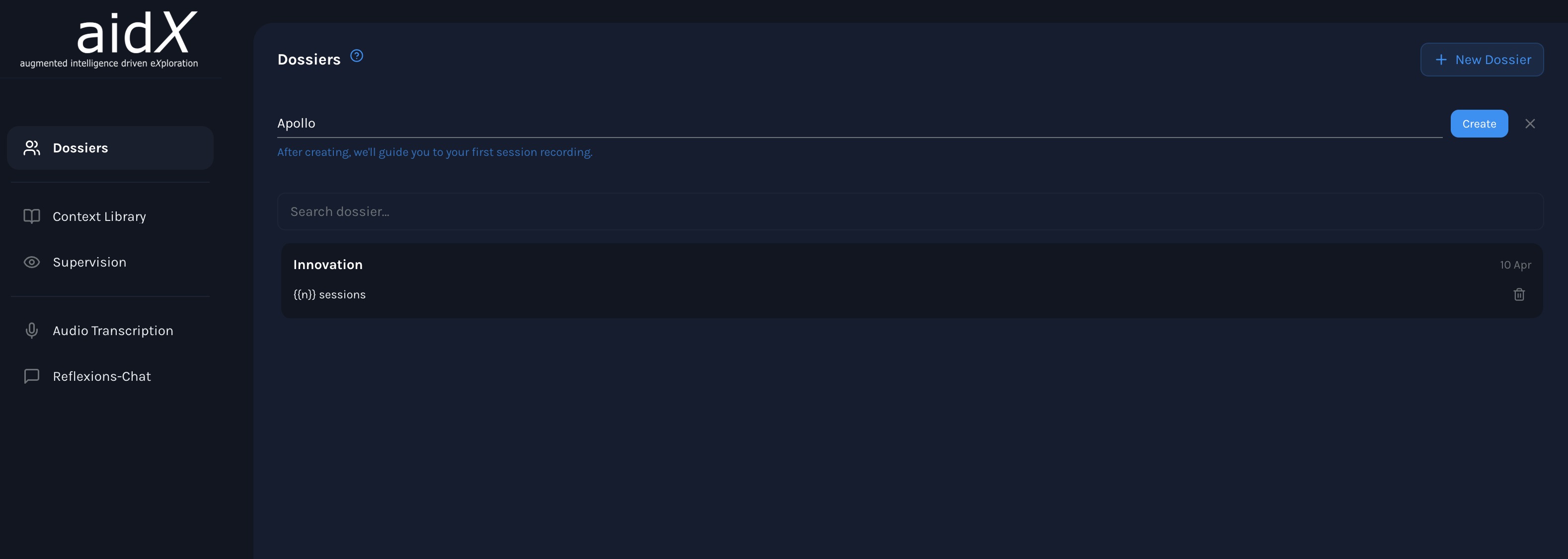
Create a file
- Open the dossier overview and click "New Dossier"
- Choose a name — it is end-to-end encrypted and visible only to you
- Optional: Add a brief note about the treatment context
- The file is ready to go — you can start recording or uploading right away
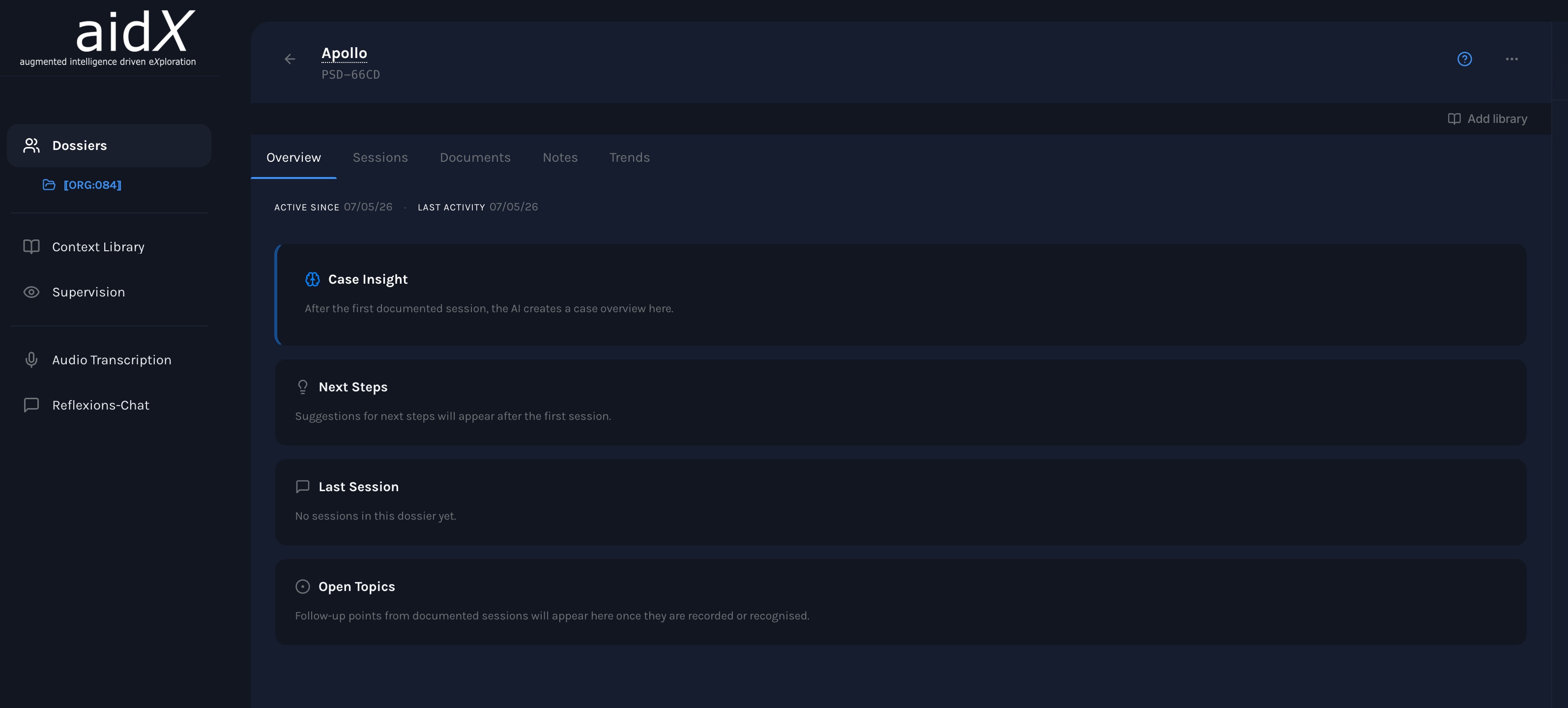
Once created, the empty file opens immediately — ready for the first session or upload.
Build a portfolio
These three types of content together provide a complete picture in the dossier.
Meetings
Every recorded or uploaded session is transcribed and documented in a structured format. The transcript is available for reference.
Recording Instructions →Documents
Upload PDFs, Word documents, and text files — reports, assessments, and preliminary documentation. Also includes reports: AI-generated drafts for official reports and forms.
Notes
Your own professional assessments, observations regarding mood or behavior, personal notes — anything that isn’t captured in the transcript should be included in the file as a note.
Trends
Observations automatically derived from the session history — signal trends, recurring themes, and AI-generated observation notes across multiple sessions. Calculated when the tab is opened.
Make the most of
-
Ask specific, context-related questions
“Which topics from the last three meetings seem to be related?” is more helpful than “What should I do?” — the more specific the question, the more relevant the answer.
-
Briefly review the transcript after each session
Check names, technical terms, and key statements — taking two minutes after the meeting ensures the long-term quality of the documentation.
-
Add observations that the microphone doesn't pick up
Body language, atmosphere, personal impressions — brief notes in the dossier, together with the transcript, paint a more complete picture.
-
Upload preliminary documentation
Existing reports and assessments are available as context as soon as they are uploaded — no need to type them out or summarize them manually.
-
Populate the context library with your methodology
Store therapeutic frameworks, protocols, and guidelines in the Context Library — the answers are tailored to your working methods, not to generic recommendations.
Archive or delete
At the end of a course of treatment, there are two options — each with very different consequences.
Archive
The file will be marked as inactive and hidden from the main view. All content will be preserved and remain accessible in encrypted form — and can be reactivated at any time.
- Complete documentation is retained
- Available immediately when treatment is resumed
- Suitable for legal retention periods
Delete file
The file and its contents will be permanently deleted and cannot be recovered. This action cannot be undone.
- All sessions, documents, and notes will be deleted
- Recovery is not possible
- Check retention requirements before deleting
How Your File Data Is Protected
End-to-end encryption
All dossier content is encrypted using AES-256-GCM. Without your personal key, the data cannot be read by anyone.
No third-party access
No unauthorized third parties or technical staff have access to the contents of your file.
Data storage in Switzerland
All data is processed and stored in Switzerland. mentalhealthGPT designed to meet the requirements of the nDSG and GDPR.
Temporary audio data
Audio is processed solely for transcription purposes. Once transcription is complete, the audio file will be deleted.
Questions about the dossier
Answers to the most important questions.
How many files can I create?
The number depends on your subscription. You can find details about the available plans on the Subscriptions page.
Can I share a dossier with someone?
Case files are personal and not intended for shared use. Content can be manually exported and pseudonymized for Supervision reporting purposes.
What happens to an archived file?
Archived files are inactive but remain fully preserved and accessible in encrypted form. They can be reactivated at any time — without any loss of data.
Can I recover a deleted file?
No. The file and its contents will be permanently deleted and cannot be recovered. Recommendation: If you are unsure, archive the file instead of deleting it.
Is the content of my files compliant with the nDSG and GDPR?
Yes. All data is processed and stored in Switzerland. The zero-knowledge architecture ensures that only you have access to your encrypted content. For more information, see Privacy & Security.